How to Choose the Best Software Development Company in Australia for Your Business Needs

Published On - October 23, 2026

Most software projects do not fall apart because the code is bad. Usually, things go sideways because someone chose the wrong partner, set fuzzy goals, or got blindsided by hidden costs after signing the contract.
If you are picking a software development company for the first time or replacing one that let you down, the decision can feel overwhelming. And honestly, it is. The right partner delivers working software, keeps you in the loop, and protects your investment. The wrong one costs you months of your time and drains your budget.
This guide lays out a straightforward way to narrow down and pick the best software development company in Australia for your needs. You will find the key questions to ask, warning signs to look out for, and what a fair deal actually looks like.
Why Choosing the Right Software Development Company Matters
Software is rarely a small purchase. It touches your customers, your staff and your data. Choosing the wrong partner has long-term consequences.
The numbers are sobering.
Capterra’s 2025 survey of Australian software buyers found that only 30 per cent said their recent software purchases fully met expectations. Among those surveyed, 40 per cent saw project timelines slip, and 36 per cent went over their planned budgets.
The public sector tells a similar story at a larger scale.
The Digital Transformation Agency’s Major Digital Projects Report 2026 found that only 60 per cent of the Australian Government’s major digital projects were rated Medium-High or High for delivery confidence.
The agency named weak project management and immature governance as the most common root causes.
Your build will be smaller than a federal program, but the lesson holds. The partner you choose matters as much as the idea you bring. The right one reduces risk before you write a single line of code.
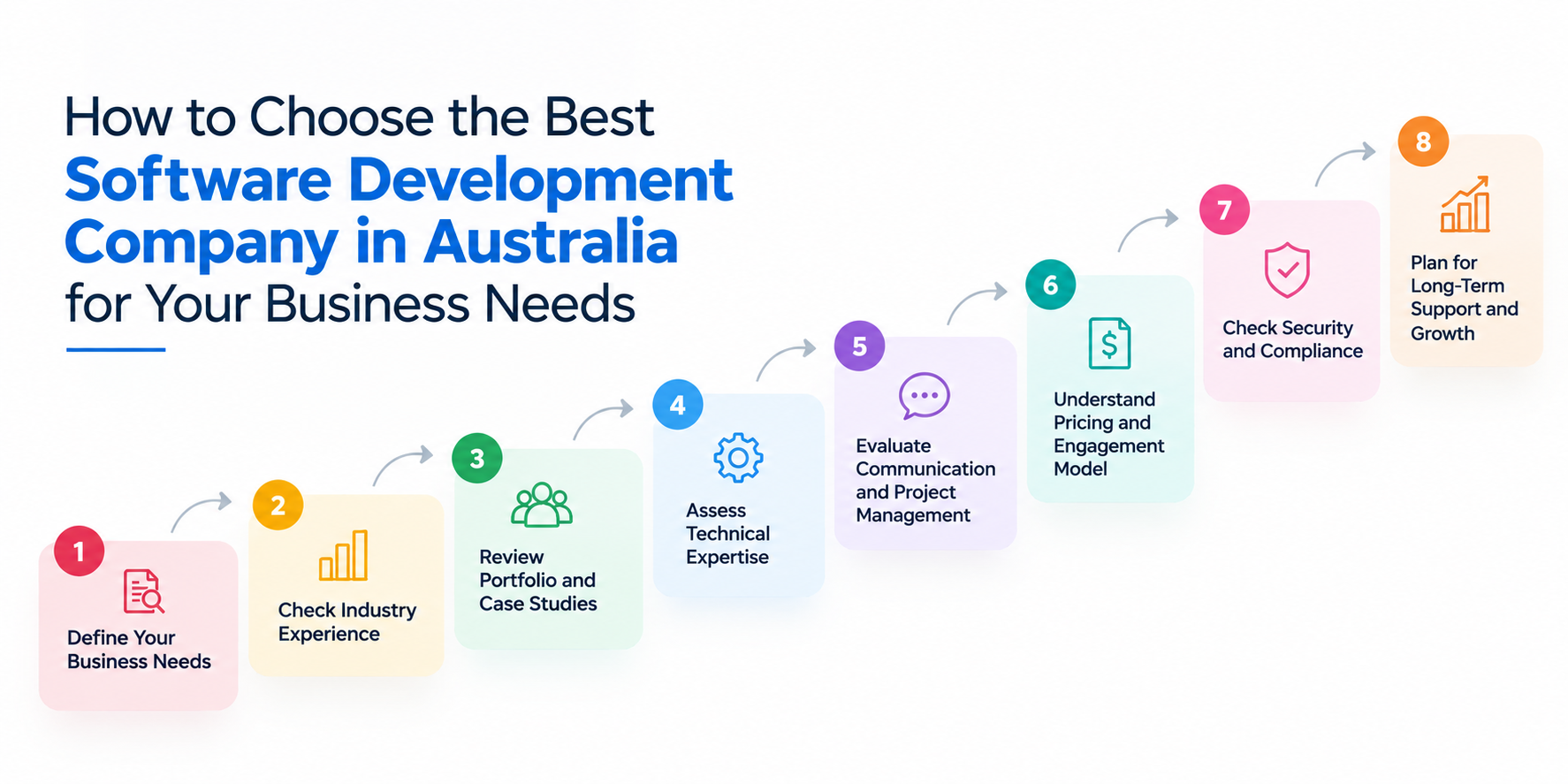
How to Choose a Software Development Company: An 8-Step Framework
Use these steps as a scorecard. Score each shortlisted vendor out of five on every point, then line them up and see how they stack up.
1. Define the Problem Before You Define the Solution
Strong partners start with your business, not the tech. Before you talk to anyone, jot down a few basics:
- What problem are you trying to solve, and who is feeling the pain
- What outcome do you really want? (Maybe it is faster quoting, fewer manual errors, or even a whole new revenue channel.)
- What is your budget, and when do you need this done
- Are there any existing systems the new software needs to connect to?
A good software development company will dig into your brief, challenge your thinking, and usually suggest a discovery phase to help you sharpen it. If someone fires off a quote after a quick call, consider that a red flag.
2. Check Technical Depth and Industry Fit
Ask which tech the team actually uses every day, and why those choices make sense for your project. You do not have to know every detail; just make sure they can explain things clearly, without jargon.
Experience in your industry matters. A team that is built for logistics, healthcare, or finance already knows the typical challenges. Ask about the actual size and seniority of their team. If you are looking for a custom software development company Australia, make sure they show you exactly who will work on your project, not just introduce you to the sales guy.
3. Review Case Studies and Speak to References
Case studies show what a vendor claims they can do. References will tell you what actually happened.
Ask for two or three past clients who had similar projects. Then talk to those clients and ask:
- Did the project finish on time and within budget?
- How did the team handle changes or bad news?
- Would you hire them again?
Also, do not skip the basics. Look up the company’s ABN on the Australian Business Register, check how long they have been around, and ask for proof of professional indemnity and cyber insurance.
4. Compare Onshore, Offshore, and Hybrid Delivery
Where the team sits affects your costs, your timelines, and how easily you can communicate. There is no single “best” answer here. The right setup depends on your needs and your project.
| Factor | Onshore (Australia) | Offshore | Hybrid |
|---|---|---|---|
| Cost | Highest hourly rates | Lowest hourly rates | Balanced |
| Communication | Same time zone, easy meetings | Time zone gaps need planning | Local lead plus a wider team |
| Speed to scale | Slower, smaller talent pool | Fast access to more developers | Fast, with local oversight |
| Compliance and data sovereignty | Simplest to manage | Needs careful contract and hosting terms | Manageable with clear controls |
| Best for | Regulated or highly sensitive work | Well-defined builds with cost pressure | Most growing businesses |
Many Australian businesses end up with a hybrid setup. You will usually have a local contact handling strategy and accountability, while the broader team handles delivery. If you are thinking about outsourcing software development Australia wide or overseas, ask exactly who owns quality and who answers your calls.

Not Sure Which Model Fits Your Project?
5. Test Their Communication and Project Management
Honestly, most projects go sideways because of poor communication, not bad code. So, find out how your vendor runs things day to day.
- Who is your main contact?
- How often will you get to see working software? Every couple of weeks is a good pace.
- What tools do they use to track progress and budget?
- How do they deal with changes in scope?
If they use an agile approach, that means you will see updates regularly, and you can course-correct easily without blowing the budget. Ask them for an example of a status report. If it is muddy or vague, expect more of the same later.
6. Understand Pricing and Total Cost
Going with the lowest quote rarely works out for the best. Software development cost Australia wide varies widely because scope, team seniority, and delivery model all affect the price. Do not just look at the headline price. Dig into the details behind each quote so you know what you are really getting.
| Pricing Model | How It Works | Best For | Watch Out For |
|---|---|---|---|
| Fixed price | One agreed price for a set scope | Clear, stable requirements | Change requests can add cost fast |
| Time and materials | You pay for hours worked | Evolving products and uncertain scope | Needs tight budget tracking |
| Dedicated team | A team works only on your product | Long-term products and ongoing roadmaps | Needs active product ownership from you |
Ask about all the extra costs that tend to pop up later, like hosting, third-party licenses, testing, project management, training, and ongoing support. What you really need to know is the total cost of ownership over the next three years, not just the build cost.
If your business could qualify for the R&D Tax Incentive, get your accountant involved early. Whether you are eligible depends on the specifics of your project, especially the rules around work done overseas.
7. Lock Down IP, Security, and Compliance
Small gaps here can turn into major headaches. Before you sign anything, lock down the details in writing:
IP ownership: You own the code, designs, and documents you have paid for.
Source code access: You can switch providers if you ever need to.
Privacy compliance: The vendor understands the Privacy Act 1988 and the Notifiable Data Breaches scheme.
Data location: You know exactly where your data is hosted and who can get to it.
Security practices: Code reviews, access controls, testing, and a response plan in case something goes wrong.
Data sovereignty matters most for government, health and finance clients. If it applies to you, make hosting location a contract term, not a verbal promise.
8. Plan for Support and Growth
Go-live is not the finish line; it is the starting point. Ask what happens after go-live:
- Do you get a warranty period for bug fixes?
- How much will support and maintenance cost, and how quickly do they respond?
- If your user base doubles, can the system handle it?
- Is the code properly documented so someone else can step in and maintain it?
Without a plan for ongoing support, technical debt starts piling up, and that is a hidden cost you will definitely feel down the track. A reliable software development partner Australia businesses can grow with will raise this before you do.
Software Development Company for Small Businesses vs Enterprise
Your company’s size really shapes what you need.
Small and Medium Businesses
If you are searching for a software development company for small businesses Australia wide, flexibility matters most. You need a team ready to start small, ship a working first version fast, and add features as your business grows. Ask about minimum project size and if they use a minimum viable product (MVP) approach.
Mid-Market and Enterprise
For enterprise software development Australia projects, things get more complex. Here, you want a developer with real experience integrating systems, a strong security process, clear steps for handling problems, and the ability to ramp up a team without sacrificing quality. Make sure you ask how they handle changes across multiple stakeholders.
In both cases, business software development Australia projects succeed when the vendor measures success by your goals, not the number of features delivered.
Red Flags When Shortlisting a Software Development Company
Walk away, or at least dig deeper, if you see any of these:
A fixed quote with no discovery work. Nobody can price a project they do not understand.
Vague answers about who does the work. You should meet the actual team.
No client references, or references that take a long time to appear.
Pressure to sign quickly, especially with a discount that expires this week.
IP stays with the vendor unless you pay extra later.
Promises of no risk. Every project has risk. Good partners tell you what it is.
No clear process for changes, which usually means surprise invoices.
Why Australian Businesses Choose GetAProgrammer
At GetAProgrammer, we understand why surprises frustrate decision-makers, so we built our whole process to avoid them from the start.
- We dive into discovery. We make sure your goals, project scope, and risks are clear before you commit.
- You always get progress updates in plain English, so you don’t have to wade through jargon or technical talk.
- When it comes to ownership, you actually own what you pay for. No hidden “lock-in” with your code.
- We are flexible, too. Pick the setup that fits your project best: fixed scope, time and materials, or a dedicated team.
- Senior consultants stick around from planning through launch and even after.
Whether you need a custom platform, a system to replace spreadsheets or extra software developers Australia wide for an existing product, we start by understanding your business and then recommend the simplest solution that works.
Ready to Compare Your Options?
Frequently Asked Questions
How much does custom software development cost in Australia?
Costs depend on scope, complexity, team seniority and delivery model. A basic tool, a mid-size platform, or a large enterprise system each falls into a totally different price bracket. If you want an accurate number, start with a discovery phase where the team figures out exactly what you need and gives you a real quote you can actually compare.
How do I choose the best software development company in Australia?
Begin with your business goals. Then, when you are looking at vendors, weigh their experience, check their references, see how well they communicate, and make sure their pricing and IP ownership terms are clear. Talk to their past clients, and ask for everything about security and compliance in writing. The best partner is not always the one with the fanciest feature list; it is the one who understands your challenges.
Should I hire an onshore or offshore software development team?
If you work with an onshore team, communication is usually smoother and legal stuff is easier. Offshore teams can save you money and help you scale faster. A lot of businesses end up with a hybrid model- a local lead and a bigger team working elsewhere. What works depends on your budget, data sensitivity, and how clearly you define your requirements.
Who owns the code when an external team builds my software?
Ownership depends on your contract. If you do not have a written IP assignment, the developer could keep rights to your code. Always agree in writing that you own the source code, designs and documentation you pay for, and confirm you can access the repository at any time.
How long does it take to build custom software?
A simple first version usually takes a few months, but if you are building something bigger with lots of integrations, expect it to take much longer. How fast things move depends on scope clarity, decision speed on your side and team size. Splitting work into stages helps you launch sooner and learn from real users.
Do I need a software development company in Sydney, or can I work with a team elsewhere?
At the end of the day, location matters far less than how the team works, how they communicate, and whether you can hold them accountable. Plenty of Australian companies work smoothly with teams elsewhere. Make sure the vendor offers overlapping working hours, a clear point of contact and compliance with Australian privacy requirements.


