How to Choose the Right Software Architecture for a Custom Business Application: Monolithic vs. Microservices vs. Serverless

Published On - November 16, 2026
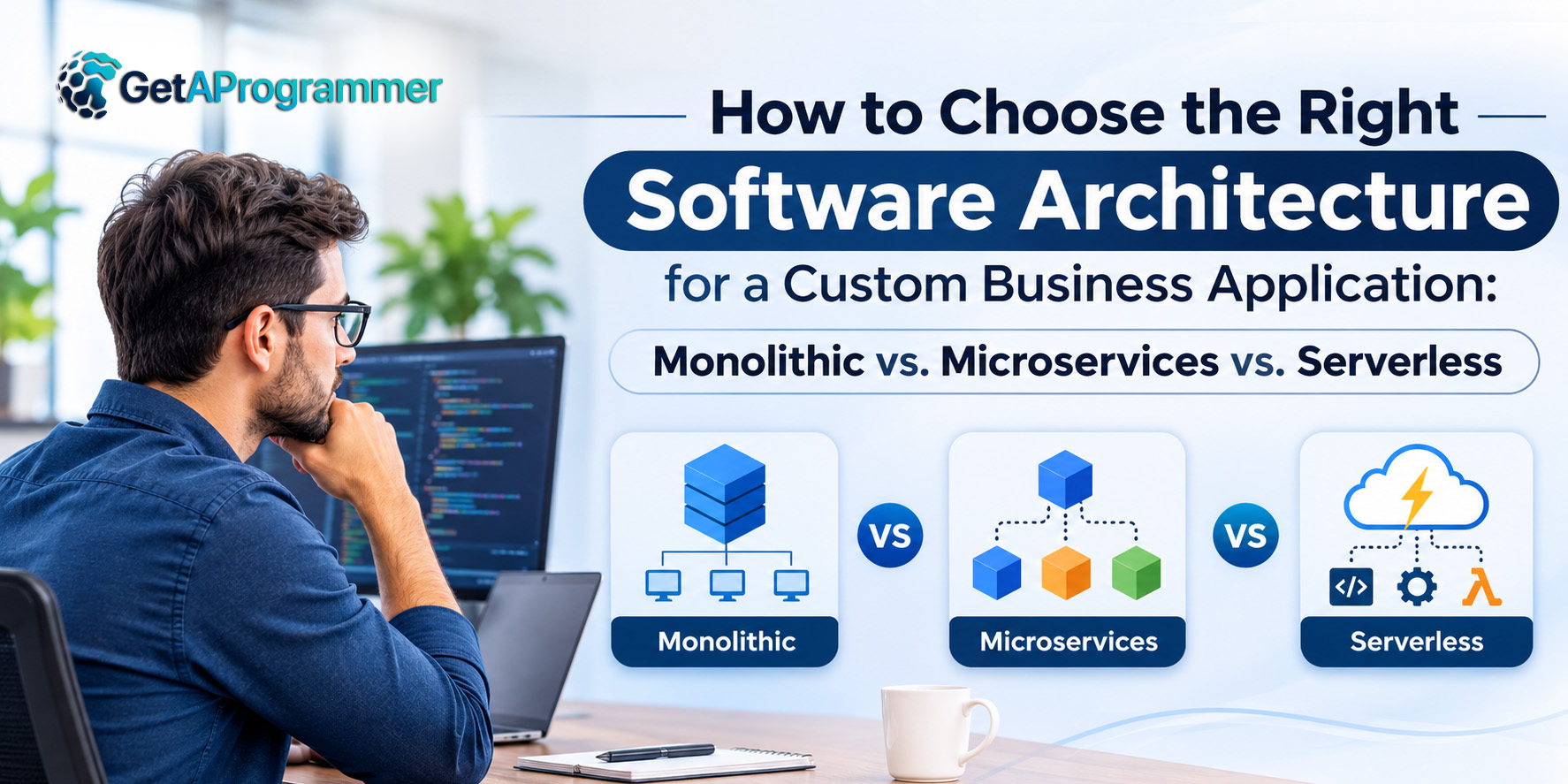
Every week, your operations manager pulls orders from one software system, puts the information in a spreadsheet, and emails it to finance. This routine happens every Friday, and when they launch a sales promotion, the website gets a huge surge of visitors and stops responding. The problem, of course, can be attributed to the software, but the real issue runs deeper and lies in the system architecture.
Software architecture is the construction plan that shows how an application works and how its components connect. It sets the principles of the application’s expansion. Get it right, and the custom software development Australia pays off for good. Otherwise, every new feature becomes more expensive than the last.
This blog compares the three main types of software architecture: monolithic, microservices and serverless. You will learn where each one fits and what it costs. We also show how an experienced custom software development company helps SMEs and mid-market businesses make that decision.
Monolithic vs. Microservices vs. Serverless: What Each One Refers To, In Other Words
Monolithic Architecture
In a monolithic architecture, the software platform is built as one whole. This means that the database layer, the business logic and the user interface are present in a central place.
The simplicity of the architecture brings its most important advantage. Having one codebase allows for faster development, easier testing and cost-effective hosting. The monolith is best suited for any type of new tool internally or for the project as a whole. This is the way small and medium enterprises start their custom software development process.
Problems start rising when business grows. Every time a minor change is implemented, a complete redeploy is required. Any issue with one of the components affects the overall process.
Microservices Architecture
A microservices architecture splits the application into small, independent services. Each service controls one business objective, such as billing, stock, or user accounts. Through APIs, which are established instructions for data sharing, the services collaborate.
While this works for larger organisations with multiple teams working on a single system, it also lets you start parts of the process independently and change any service without affecting the rest.
However, this architecture also brings many complications. Multiple deployments, more monitoring, and communication between multiple services are now your commitments. In essence, SMBs adopt microservices too early and end up spending funds on infrastructure instead of product innovation.
Serverless Architecture
The serverless architecture executes a series of code in small functions, activated by the cloud provider. The customer incurs charges only when the code is executed, instead of owning the equipment, which is also taken care of by the service provider.
Serverless computing has become commonplace. According to the 2023 State of Serverless report, more than 70% of AWS users are utilising at least one serverless option. This rate is 60% for Google Cloud customers.
Serverless is ideal for event-driven tasks such as upload processing, alerts, and handling traffic surges. However, it is not suitable for activities that run for long periods, and it can be costly if the volumes are extremely high and steady. Vendor lock-in may also be an issue. In the realm of serverless vs. microservices, the main criterion usually becomes the type of workload involved.
| Factor | Monolithic | Microservices | Serverless |
|---|---|---|---|
| Best for | New products, internal tools, small teams | Large platforms with several teams | Event-driven jobs and spiky traffic |
| Build speed | Fastest to start | Slowest to start | Fast for small functions |
| Scaling | Whole app scales together. | Each service scales on its own | Scales automatically on demand |
| Running cost | Low and predictable | Higher, with more infrastructure | Pay per use, can climb at high steady volume. |
| Team effort | Low | High | Low to medium |
| Main risk | Slows down as it grows | Complexity and overhead | Vendor lock-in |

Not sure which model fits your application?
GetAProgrammer can help you get a clear recommendation before you write a line of code.
Why Architecture Decides the Success of Custom Software Development
Architecture is the hardest decision to reverse. You can change a screen in an afternoon. Changing how an application stores data or handles traffic can take months.
A recent study indicates that making a mistake can be quite expensive. Pegasystems-sponsored Savanta research in 2025 surveyed more than 500 IT decision-makers regarding legacy systems. Of the respondents, 47% said their oldest legacy application was between 11 and 20 years old. Another 37% cited having different, disconnected systems.
Three questions are addressed by effective software architecture for custom business applications. In 3 years, how many users will there be? How often will it be updated? What is the capacity of your team? In the realm of custom-made business apps, a suitable choice stays out.
How to Choose the Right Software Architecture: A 6-Step Checklist
Choosing the right software architecture requires shaping the design to your company’s needs rather than following trends.
Before committing to any software architecture design, follow the steps below:
- Identify your extent. For now, know the amounts for the first and third years of users, transactions, and documentation.
- Map your team. Three developers will struggle to run 20 microservices. A monolith or serverless setup is easier to manage.
- Scrutinise your progress. When several parts of the system evolve in differing ways, microservices make sense.
- Evaluate your traffic. A serverless design is suitable for erratic and occasional traffic. Containers or monolithic applications gain from steady and extensive traffic.
- List every implementation. List every tool that the application has to interconnect with, such as payment gateways, ERPs, and CRMs.
- Evaluate the total costs. Assess and compare the costs of everything from development to application hosting and monitoring to maintenance for three to five years.
Numerous companies adopt a hybrid custom software architecture. A modular monolith is described as a single program with distinct internal divisions.
It provides the possibility to segregate services as demands increase. This renders it an efficient and scalable software architecture for small and medium-sized enterprises.
Build The Software the First Time With GetAProgrammer, A Custom Software Development Company
Choosing the best technology is not a matter of selecting something contemporary. It is about aligning the architecture with your target audience, team and expansion strategy. A monolith fits specialised instruments and initial products best. Microservices fit big platforms with numerous teams. Serverless technology is suitable for unpredictable workloads brought about by events. Most companies will benefit from a combination of these approaches. GetAProgrammer’s custom application development solutions follow the assessment of your strategy and architecture.
Before recommending a software development project, a reputable custom software development Australia examines your existing systems and workflows, as well as your plans. Such an examination often helps to identify some immediate solutions, such as linking two programs that are currently operated with the help of spreadsheets. GetAProgrammer provides custom software development services from architecture to implementation for both small companies and mid-sized businesses. The custom software company works according to Australian working hours to suit local businesses.
Ready to plan your next build?
Get a Free Software Readiness Assessment from GetAProgrammer and see where your current systems stand.
Frequently Asked Questions
Q. What is the best software architecture for a small business?
A good monolithic architecture is a great starting point for a small business. Building it is faster, hosting it is cheaper, and maintaining it is simpler. After some time, it is possible to transfer parts to microservices or serverless models.
Q. Is microservices vs monolithic architecture mainly a cost question?
In part. Microservices architecture is more expensive because of the additional infrastructure and monitoring expenses. They are economical when different teams are developing their segments of the system successfully.
Q. When should I choose serverless vs microservices?
A serverless software architecture design would be proposed in the event of unprecedented situations, such as those brought on by unpredictable traffic increases or other instances. However, a microservices strategy is best when creating prolonged services, executing with runtime control, or operating different functions simultaneously.
Q. Can I change my custom software architecture later?
Yes, but it costs time and money. Clean boundaries in your software architecture design make a later move much easier. That is why the first design decision matters so much.
Q. What does enterprise application architecture include?
The subject of custom software architecture entails multiple linkages and data exchanges among various core systems, including ERP, CRM, and finance applications. The best custom software development eliminates duplicate entries and provides one repository of information.
Q. How long does custom business application development take?
The timeline is dependent on the scope. For example, some projects take longer. A fixed custom software development project can be done in a few months; a complicated system with many integrations will take more time. A brief discovery phase will help you get a better estimate.


