Custom Software Development in Australia: A Technical Guide to API Integration, Database Design, Cloud Infrastructure, and System Scalability

Published On - November 17, 2026
Your business has hit a wall with its software. Your CRM does not sync with your accounting tool. Every morning, staff waste time moving data between three platforms. And the SaaS app you picked a couple of years ago now charges for every user, yet you cannot tweak the features you actually need.
This is the point where many Australian CTOs and founders start looking at custom software development. Done well, it gives you a system built around how your business actually works. Done poorly, it becomes an expensive rebuild within three years.
So, what makes the difference? It usually boils down to four big technical choices at the start: how your systems connect, where you store your data, where the software runs, and how it handles heavy use as your business grows.
This guide breaks down each decision without jargon: it shows you what is ideal, the key questions to ask, and common mistakes to avoid.
Why Australian Businesses Are Choosing Custom Software Development
Off-the-shelf software is a sensible starting point. It is quick to set up and cheap at small scale. The problems appear as you grow.
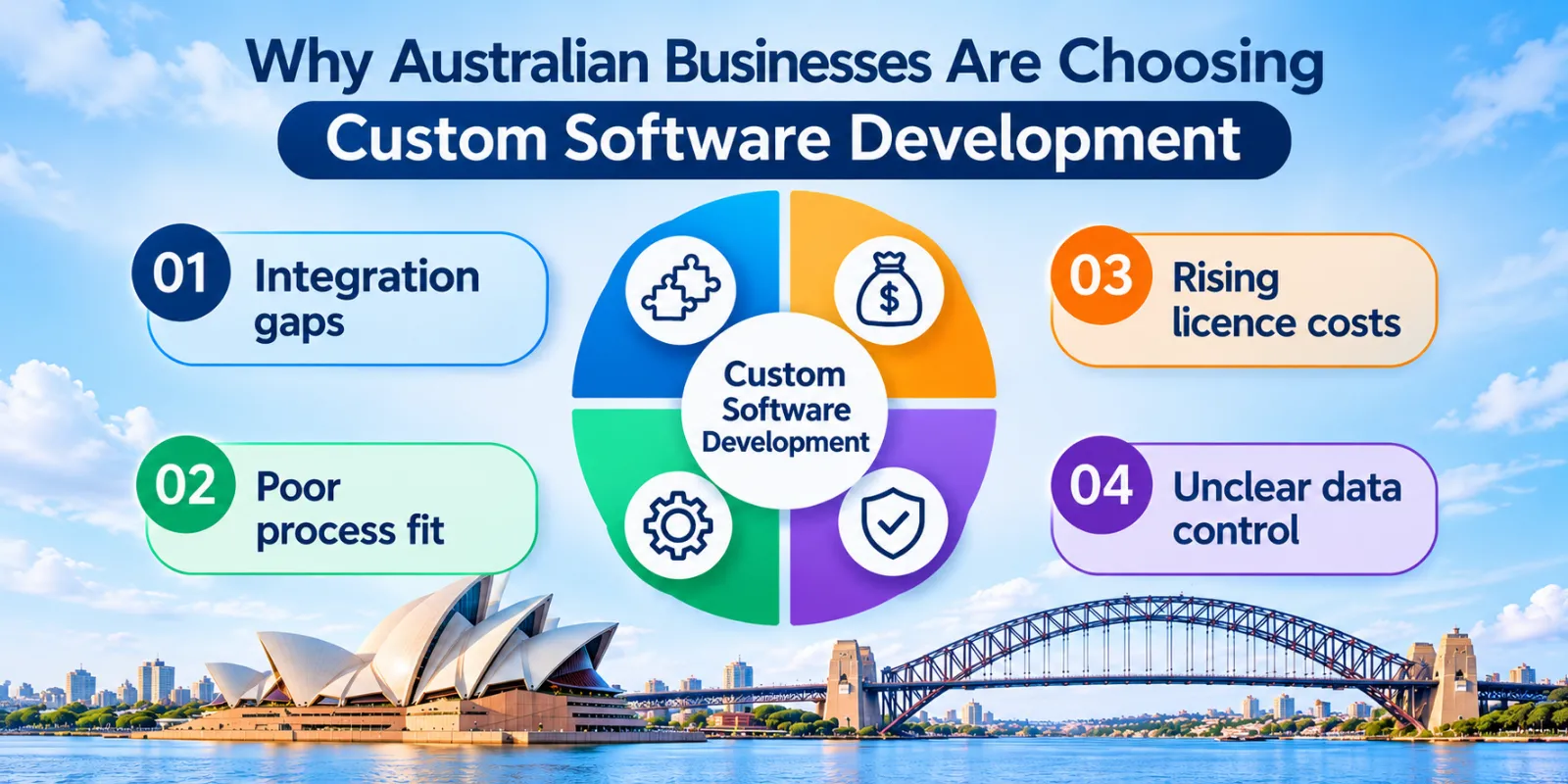
- Integration gaps: Generic tools rarely connect cleanly to your existing stack, so staff fill the gaps by hand.
- Rising licence costs: Per-seat pricing grows with headcount, not with value.
- Poor process fit: You change how you work to suit the software, rather than the other way around.
- Unclear data control: You may not know where customer data is stored or who can reach it.
That last point matters more each year.
The Office of the Australian Information Commissioner (OAIC) received 1,205 data breach notifications in 2025, an 8% rise on 2024 and the highest annual total since the Notifiable Data Breaches scheme began in 2018 (OAIC, July 2026).
Under the Privacy Act 1988, your business is accountable for personal information, even when a vendor stores it.
This is why demand for custom software solutions in Australia keeps growing. The goal is not to replace every tool you own. It is to build the pieces that give you an edge, then connect them to the tools that already work. That is the real value of software development for Australian businesses: technology shaped around the way you operate.
API Integration: The Backbone of Connected Systems
An API (Application Programming Interface) is the doorway that lets two systems share data. Good API design turns a collection of tools into one working system. Poor API design is why many businesses still export spreadsheets every Friday afternoon.
REST, GraphQL or Webhooks?
| Approach | How It Works | Best For |
|---|---|---|
| REST | Fixed endpoints return set data structures | Most business systems and partner integrations |
| GraphQL | The app asks for exactly the fields it needs | Mobile apps and dashboards pulling from many sources |
| Webhooks | One system pushes an alert when an event happens | Real-time triggers such as payments, orders and form submissions |
Most projects use a mix. A sound custom API development plan picks the right approach for each connection, rather than forcing one style everywhere.
Common Australian Integrations
Typical software system integration work for local businesses includes:
Accounting platforms such as Xero and MYOB
CRM and ERP platforms such as Salesforce, HubSpot, Odoo and Microsoft Dynamics
Payment gateways such as Stripe and Square
Government services such as the ATO’s Standard Business Reporting (SBR) and Single Touch Payroll
Security Is Not Optional
Every API is a potential entry point for attackers. Ask any provider of API integration services in Australia how they handle:
- Authentication using OAuth 2.0 or signed tokens
- Rate limiting to stop abuse and accidental overload
- Versioning so updates do not break connected systems
- Audit logging so you can trace who accessed what and when
Database Design and Development: Planning for Data You Do Not Have Yet
Your database outlives almost every other part of your system. Screens get redesigned, and features change, but the data model tends to stay. That is why database design and development deserve more attention at the start than it usually gets.
Relational or NoSQL?
| Factor | Relational (PostgreSQL, MySQL) | NoSQL (MongoDB, DynamoDB) |
|---|---|---|
| Data structure | Fixed tables with defined relationships | Flexible documents or key-value pairs |
| Consistency | Strong, ideal for transactions | Often relaxed, tuned for speed |
| Best for | Finance, inventory, bookings and ERP-style data | Activity logs, content and high-volume events |
| Scaling style | Mostly a bigger server, plus read copies | Built to spread across many servers |
| Reporting | Mature SQL tools | Needs extra work for complex reports |
Many modern systems use both: relational for orders and payments, NoSQL for logs.
Design Habits That Prevent Pain Later
- Normalise early: Store each fact once so records never conflict.
- Index for real queries: Indexes speed up the searches your users actually run.
- Test your recovery: A backup you have never restored is only a hope.
- Keep data onshore where needed: Hosting in an Australian region simplifies Privacy Act obligations and reassures clients about data sovereignty.
Ask a vendor to walk you through a data model from a past project. It reveals more than any sales deck.
Cloud Infrastructure for Software Development
Cloud is now the default home for new business systems.
Gartner forecasts Australian organisations will spend AA$33.6 billion on public cloud services in 2026, up 17.9% from A$28.5 billion in 2025 (Gartner, May 2026).
Infrastructure services are the fastest-growing segment, up 24.1%.
The right cloud infrastructure for software development depends on your workload, budget and compliance needs.
Choosing a Platform
All three major providers run Australian data centres:
- AWS: Sydney and Melbourne regions
- Microsoft Azure: Australia East (Sydney), Australia Southeast (Melbourne) and Australia Central (Canberra)
- Google Cloud: Sydney and Melbourne regions
For most SMEs, the best choice is the platform your team can support and that your existing tools already use.
Serverless or Containers?
- Serverless (AWS Lambda, Azure Functions): You pay per request, and the provider manages the servers. It suits spiky or event-driven workloads.
- Containers (Docker, Kubernetes): You package the app with everything it needs to run. It suits steady workloads and teams that want more control.
The Supporting Pieces
Cloud-based custom software development also needs:
- CI/CD pipelines that test and release code automatically
- Monitoring and alerts so issues are caught before users report them
- Cost controls such as budgets, tagging and right-sized servers
Without cost controls, cloud bills creep up quietly. Ask how your partner will keep them in check after launch.
System Scalability: Designing for Growth From Day One
Scalability is your system’s ability to handle more users, data and transactions without slowing down or falling over. It costs far less to plan for than to retrofit.
Vertical vs Horizontal Scaling
- Vertical scaling means moving to a bigger server. It is simple, but it has a ceiling.
- Horizontal scaling means adding more servers that share the load behind a load balancer. It takes more planning but grows much further.
Caching with tools such as Redis also helps. It stores frequent results so the database does less work.
Monolith or Microservices?
| Factor | Monolith | Microservices |
|---|---|---|
| Structure | One codebase, released as a unit | Many small services, released separately |
| Speed to launch | Faster | Slower |
| Suits | Small to mid-sized teams | Larger teams with strong DevOps skills |
| Scaling | Scale the whole app | Scale only the busy parts |
| Running cost | Lower | Higher |
Here is an honest view. Most startups and SMEs should begin with a well-structured monolith. Microservices solve scale problems you may not have yet. Good custom software architecture keeps the code modular, so you can split out services later when the numbers justify it.
Why Early Choices Matter
Shortcuts taken to hit a deadline become technical debt: code that works today but costs more to change tomorrow.
Research by McKinsey and the University of Oxford, covering more than 5,400 IT projects, found that large IT projects run 45% over budget and 7% over time on average, while delivering 56% less value than predicted.
A scalable software architecture is one of the best defences against becoming part of that statistic.

Not sure your current system will cope with the next stage of growth?
What to Ask a Custom Software Development Company Before You Sign
A polished proposal can hide a weak process. These ten questions help you see the difference.
- Who owns the code and IP? You should own it outright on final payment.
- Where is the team based? Is the team onshore, offshore, or blended, and who is your day-to-day contact?
- How do you document the system? Ask for API documentation, data models and deployment guides.
- What does your testing cover? Look for automated unit, integration and security testing.
- How do you handle scope changes? A clear change process protects both budget and timeline.
- What security standards do you follow? The Australian Cyber Security Centre’s Essential Eight is a strong baseline.
- How will you avoid vendor lock-in? Look for open standards, common languages and full repository access.
- What happens after launch? Ask about support SLAs, response times and maintenance costs.
- Can we speak to a past client? References show how a team behaves when things go wrong.
- How often will we see working software? Fortnightly demos keep surprises small.
Any serious custom software development company Australia businesses rely on should answer these clearly and in writing.
Cost and Timeline: What Drives the Numbers
Custom software has no fixed price. Cost depends on what you build, how it connects and how fast you need it. The main drivers are:
- Scope: the number of features, user roles and screens
- Integrations: each external system adds design, testing and upkeep
- Compliance: privacy, security or industry rules add review time
- Team model: onshore, offshore and blended rates differ widely
- Timeline pressure: compressed schedules need larger teams
Indicative Ranges
The figures below are indicative ranges only, not quotes. Ranges vary by scope, team model and complexity.
| Project Type | Indicative Timeline | Indicative Cost (AUD) |
|---|---|---|
| MVP or internal tool | 2 to 4 months | $40,000 to $120,000 |
| Business platform with several integrations | 4 to 9 months | $120,000 to $350,000 |
| Enterprise system | 9 to 18+ months | $350,000+ |
Reducing Cost and Timeline Risk
- Start with a discovery phase that locks scope before the full build.
- Launch an MVP, then expand based on real usage.
- Use fixed-price phases for well-defined work and time-and-materials for the rest.
For enterprise software development in Australia, a paid discovery phase is close to essential.
How GetAProgrammer Approaches Custom Software Development Services
GetAProgrammer is a Sydney-based custom software development company, based in Chatswood, working with startups, SMEs, and larger organisations across Australia.
Our custom software development services follow the same principles set out in this guide.
- Requirements first: We take time to understand your goals and systems, then give you a clear timeline before the build starts.
- A proven, open stack: React, Angular, Node.js, .NET, Laravel and MongoDB, so you are never tied to obscure tools.
- Integration expertise: We connect custom builds to the platforms you already use, including Odoo, Salesforce and Microsoft Dynamics.
- Web, mobile and beyond: From web platforms to iOS, Android and IoT applications.
- Support after launch: Ongoing support, updates and maintenance keep your software secure and current.
The result is software that fits how your business works today and grows with where it is heading.
Build It Right the First Time
Successful custom software development rests on four foundations: clean API integration, a well-planned database, the right cloud setup and an architecture that scales. Get them right, and your software becomes a lasting asset. Get them wrong, and you pay for it in rework, downtime and missed growth.
So which of the four is the weakest link in your current setup?
CTA: Ready to scope your project? Book a free, no-obligation consultation with GetAProgrammer.
Frequently Asked Questions
Q. How much does custom software development cost in Australia?
A. Cost depends on scope, integrations, compliance needs and team model. As an indicative guide only, an MVP may start around $40,000, while enterprise software development in Australia often exceeds $350,000. A paid discovery phase gives you a far more reliable figure than any early estimate.
Q. How long does it take to build custom software?
A. A focused MVP typically takes two to four months. A business platform with several integrations may take four to nine months. Timelines depend on scope, feedback speed and how much software system integration is involved. Phased releases let you start using core features sooner.
Q. Should I choose a local or offshore custom software development company?
A. A local custom software development company in Australia offers easier communication, shared business hours and familiarity with the Privacy Act. Offshore teams can offer lower rates. Many businesses choose a blended model, with local project leadership and a wider delivery team behind it.
Q. What are API integration services and why do I need them?
A. API integration services connect your software to the tools you already use, such as Xero, Salesforce or payment gateways. Custom API development removes manual data entry, reduces errors and gives you one accurate view of your business across every system.
Q. Is custom software better than off-the-shelf SaaS?
A. Not always. SaaS suits standard processes. Custom software solutions make sense when your processes are unique, your integrations are complex, or licence costs keep rising. Strong software development for Australian businesses often combines both: custom builds where they create an edge, SaaS where it already works.
Q. How do I make sure my software can scale?
A. Scale starts with design. Good custom software architecture, sound database design and development, and the right cloud infrastructure for software development all play a part. Ask your partner which software scalability solutions they recommend, such as caching, load balancing and cloud-based custom software development, and how each supports a scalable software architecture as you grow.


