Custom Web Application Development: When Does Your Business Need a Web App Instead of a Website?

Published On - October 27, 2026

Your website works well. You get traffic on some search phrases and visitors through the contact form. And there the job really begins.
Your team copies the request into an Excel spreadsheet, someone builds a quote in MS Word, and the manager needs three days to approve it by email.
If this all sounds familiar, it is definitely not your website. The problem is that you are asking a marketing tool to handle operational processes. This is where custom web application development stops being a good idea and becomes a business necessity.
This is a quick answer to our topic, but let us dive deeper. If your employees or clients need to log in, enter data, run workflows, and see information that changes based on the user, then you need a web application. If all people need is to learn about you and contact you, a website would suffice.
In this article, you will find a complete explanation of the difference between a website and a web application, seven signs you need the latter, its average cost in Australia, and how to choose the right partner.
Website vs Web Application: What Is the Real Difference?
Website development aims to provide information. Web applications are built to do work. Both run in a browser, so that the dividing line can blur from an external perspective. However, inside, the purpose of development, the process, and the costs associated with it differ significantly.
| Factor | Website | Web Application |
|---|---|---|
| Main purpose | Inform, build trust, generate enquiries | Complete tasks, process data, run workflows |
| Users | Mostly anonymous visitors | Logged-in staff, customers or partners |
| Interactivity | Menus, content, contact forms | Dashboards, approvals, calculations, live updates |
| Data | Mostly static content | Stores, processes and reports on business data |
| Integrations | Analytics, CRM form capture | APIs to ERP, CRM, payments and accounting systems |
| Security | Standard hosting security | User authentication, role-based access, encryption, audit logs |
| Examples | Company site, blog, brochure site | Customer portal, booking platform, SaaS product, operations tool |
Put differently, websites provide potential customers with information about what a business offers. Web applications let customers order services, track orders, and pay without calling the business’s office.
This is how web application development for businesses differs from website development: it focuses more on functionality than appearance.
7 Signs Your Business Needs a Web App Instead of a Website
Determining whether you need to develop a web application largely depends on identifying friction.
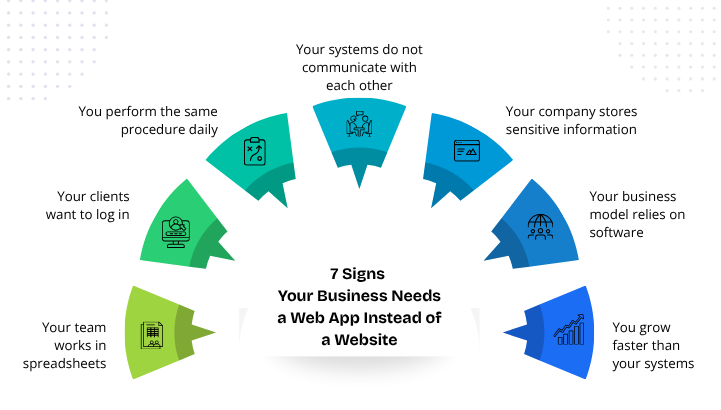
These seven signs pop up repeatedly during discovery processes with Australian companies.
Your team works in spreadsheets
Spreadsheets are a good way to start but not a sustainable solution. With multiple editors involved, version problems appear sooner or later. A logistics company managing hundreds of weekly deliveries in spreadsheets loses valuable hours reconciling data, while a web application records everything once and correctly.
Your clients want to log in
When your customers constantly ask, “Can I check the status myself?”, you need a client portal. Web applications offer login, user permissions, and personalisation.
You perform the same procedure daily
Issuing quotes, allocating jobs, requesting approvals and onboarding new clients require the same set of actions each time. For standard procedures, software should automate them. Workflow automation is a major source of high ROI.
Your systems do not communicate with each other
Employees duplicate information when entering it into your CRM, accounting system, and job system. A custom application with API integration unifies all these services.
Your company stores sensitive information
Personal health records, finances, and identity documents require protection under the Privacy Act 1988 and the Australian Privacy Principles.
OAIC received 1,205 data breach notifications in 2025, an 8% increase from 2024, the largest annual number since the scheme’s introduction in 2018.
A custom application will give you full control of access, encryption, and audit trails.
Your business model relies on software
If you are a startup considering a subscription product, marketplace or booking service, a web application is your business. A brochure site will not work.
You grow faster than your systems
Every employee should increase output, not administrative workload. If every employee adds coordination effort, the system itself is the bottleneck. Well-designed business web app solutions scale with your users and data instead of fighting them.
Do you see at least three of these signs? That is typically the moment when building becomes cheaper than not building.
What Custom Web Application Development Involves
Custom web application development requires following a clear sequence. Mistakes happen when teams skip steps, and budgets get busted.
Research by McKinsey and the University of Oxford across more than 5,400 large IT projects found they ran 45% over budget on average and delivered 56% less value than predicted.
Small projects are not an exception. They just fail silently.
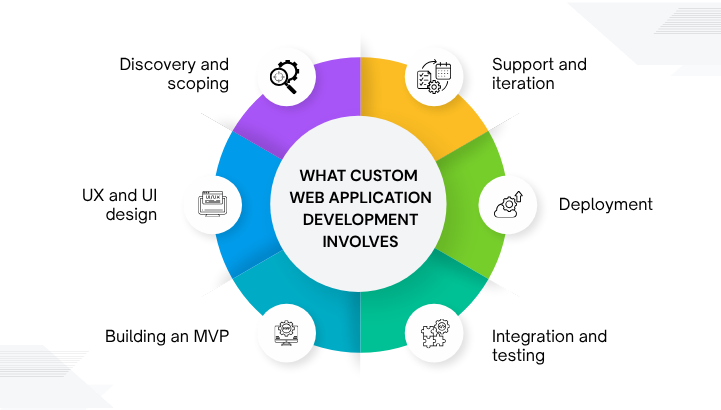
The right approach involves the following steps:
- Discovery and scoping: Define users, workflows, integrations, and success measures before writing any code.
- UX and UI design: Wireframes and interactive prototypes let you test the UX.
- Building an MVP: Launch the minimal version of the app first and then improve it.
- Integration and testing: Integration of APIs and testing for security, performance and edge cases.
- Deployment: Release on scalable cloud hosting with monitoring in place.
- Support and iteration: Fix, refine and add features based on real usage data.
Quality web application development services should encompass all of the above steps, not just the building. For CTOs and IT managers, make sure you know about the architecture of the app, its hosting, ownership of the code and documentation. For product managers, ask how feedback loops and release cycles will work after launch.

Not sure whether you need a web app yet?
How Much Does Custom Web App Development Cost in Australia?
There is no honest single price, because scope drives cost.
The ranges below are indicative only, based on typical Australian market rates. Actual costs vary by scope, integrations and compliance needs.
| Project Type | Typical Scope | Indicative Cost (AUD) | Indicative Timeline |
|---|---|---|---|
| Simple internal tool or MVP | 1 to 2 user roles, one core workflow, basic reporting | $25,000 to $60,000 | 6 to 12 weeks |
| Customer portal or mid-size business app | Several user roles, integrations, dashboards | $60,000 to $150,000 | 3 to 6 months |
| SaaS platform or complex enterprise app | Multi-tenant, payments, advanced security, large scale | $150,000 to $400,000+ | 6 to 12+ months |
What moves the price most:
- User roles and permissions: every extra role adds screens, rules and testing.
- Integrations: ERP, CRM, payment gateways and legacy systems each add effort.
- Security and compliance: health and finance projects need deeper controls.
- Design complexity: custom interfaces and accessibility standards take more time.
- Ongoing costs: hosting, maintenance, and new features need a yearly budget from day one.
Before you compare quotes, compare scope. An AUD 40,000 quote and an AUD 120,000 quote for “the same app” usually describe two very different products. Ask any web application development services provider for a line-by-line breakdown, and question anything vague.
Off-the-Shelf SaaS vs a Bespoke Web Application
Most Australian businesses already run on subscription software.
ABS data shows 55% of businesses used paid cloud computing in 2019-20, up from 42% in 2017-18.
So the real question is rarely “software or no software”. It is “rent or build?”
| Factor | Off-the-shelf SaaS | Custom Web Application Solutions |
|---|---|---|
| Upfront cost | Low | Higher |
| Time to start | Days | Weeks to months |
| Fit to your process | You adapt to the tool | The tool fits your process |
| Integrations | Limited to what the vendor offers | Built around your systems |
| Ongoing cost | Per-user fees rise as you grow | Hosting and maintenance, no per-seat licences |
| Ownership | Vendor owns the product and roadmap | You own the code and IP, when contracted correctly |
| Competitive edge | Same tools as your competitors | Unique to your business |
Here is the honest advice. If a good SaaS product covers 80% of your needs, start there. Build custom when the remaining 20% is where you win or lose customers.
The benefits of custom web applications usually show up in four places:
- Efficiency: fewer manual steps and fewer costly errors.
- Customer experience: self-service portals that customers actually use.
- Better data: one source of truth for reporting and decisions.
- Asset value: software you own adds value to your business.
Choosing the Right Web App Development Company in Australia
Your partner is as important as the technology itself. If you are comparing providers for custom web application development Australia wide, use this checklist before you sign anything.
| What to Check | Why It Matters | Question to Ask |
|---|---|---|
| Local timezone | Faster answers during Australian business hours | Who is my day-to-day contact, and where are they? |
| IP ownership | You should own the code you pay for | Does the contract transfer all code and IP to us? |
| Security practices | Protects your data and your reputation | How do you handle authentication, encryption and testing? |
| Privacy compliance | Reduces legal and breach risk | How do you design for the Privacy Act and the NDB scheme? |
| Transparent pricing | Avoids surprise invoices | Can you break the quote into phases with fixed scope? |
| Post-launch support | Keeps the app stable and current | What are your support terms and response times? |
| Relevant experience | Lowers delivery risk | Can you show business web application development work at our scale? |
Make security a top priority.
The 2026 OAIC community attitude survey showed that 82% of Australians worry about data breaches, up from 74% in 2023.
Your clients will evaluate the app’s security.
Lastly, choose a web app development company that manages all phases of development in-house. Strong custom web app development services keep accountability in one place, so nothing gets lost between vendors.
Build the Right Solution for Your Business, Not Just a Website
The website gains attention. The web app gains efficiency, loyalty, and scalability. Your company will have clearly outgrown its website if it constantly struggles with spreadsheets, enters the same information twice, or receives constant updates on what everyone is doing.
GetAProgrammer offers custom web app development Australia wide to entrepreneurs, startup owners, CTOs, and product owners. Our custom web app development services range from discovery, design, and implementation to integration and ongoing support, so you work with one responsible team throughout the process.
Whether you need web application development for businesses at an early stage or custom web application solutions for an established operation, the first step is the same: a clear, honest conversation about your goals. Proven business web app solutions start with understanding how your business really runs.
Ready to stop running your business on spreadsheets and workarounds?
Frequently Asked Question
What is custom web application development?
It means designing and developing browser-based software to match your business processes, users, and data. While a template website or off-the-shelf tool may not account for your business specifics and may not even be owned by you, a custom web app is built specifically around how your business operates, and you usually own the code.
Website vs web application: which does my business need?
A website would suit businesses that need to exchange information and receive inquiries. A web application suits businesses whose users need to log in, perform certain tasks, process data, or follow particular workflows. Many businesses use both, while a website helps generate leads for a web application.
How do I know when to build a web application?
Build it if existing off-the-shelf tools create expensive workarounds, if your workflow is your competitive advantage, if you need complex integrations, or if your product is the software itself. If a SaaS tool already covers most of your requirements, start there.
How much does a custom web app cost in Australia?
Indicative price ranges start at around AUD 25,000 to AUD 60,000 for a basic tool or MVP, AUD 60,000 to AUD 150,000 for a mid-sized business application, and AUD 150,000+ for a complicated platform. These ranges vary based on scope, required integrations, and security needs. Therefore, a scoping session will give you the best estimate of costs.
How long does it take to build a web app?
An MVP focused on a specific goal can be developed within 6-12 weeks. A mid-size portal would take around 3-6 months, while more complicated platforms can take even longer. The business web application development timeline depends mainly on scope, integrations, and how quickly stakeholders provide feedback.
What are the benefits of custom web applications?
Benefits of custom web applications include a strong fit with processes, automation of routine operations, deep integration with existing software, increased security, opportunities to scale, and ownership of the application and related IP.


