From Business Idea to Software Product: How to Plan, Build, and Launch an MVP

Published On - November 11, 2026
You’ve been operating your company using spreadsheets, an outdated CRM system, and three apps that don’t communicate with each other. One day, you observe a void in the marketplace. Your clients demand something the available tools can’t provide. You come up with an idea for a new product and write it on the whiteboard.
Then the quotations come in, and you suddenly realise custom software development will take almost a year, and your product may need as many as sixty features. Meanwhile, another developer proposes a solution that covers half the issue. You start to think your brilliant idea is just speculation.
But it really shouldn’t be a speculation. You need a minimum viable product development (MVP), a small working version that confirms people want it.
How Does an MVP App Development Work for Any Business Process?
The MVP (Minimum Viable Product) is a basic, functional version of your product that solves a specific issue for a specific user group. It is neither a demo-ready test version nor a lab prototype. It has real users and must operate as intended.
Knowing how to learn is key to MVP development cost. Each functionality must address one question: does it support or refute our theory? Consider a food truck used to explore a restaurant’s menu, pricing, and location before opening for good. If customers queue up, you scale. If they walk past, you change course before the losses grow.
It’s not just startups that can construct an MVP. An established business can also use it as a field service app or a new client portal. It is best to run a test with a single team or customer group before introducing the solution to everyone. This way, custom software development becomes a series of small, manageable, and safe steps instead of a risky undertaking.
MVP Examples Businesses Already Employ
Some of the world’s best-known items started as small-scale MVPs.
Dropbox started with a simple demonstration video. The developers showed how file sync would work before the full product was finalised, and the ensuing spike in sign-ups proved there was demand. When its founders decided to host visitors on inflatable beds in their San Francisco apartment, Airbnb was born. A simple website tested whether strangers would pay to stay in a home.
Zappos tested online shoe sales by posting photos of shoes from local stores. When an order came in, the founder bought the pair and shipped it. Only after people kept buying did the company invest in stock and warehouses.
None of these MVPs looked impressive. Each one answered a single question cheaply: will people actually use and pay for this?
Software Implementation Process: Validate Your Idea Before the Project Begins.
Many product failures stem not from poor code, but from a lack of demand. Plan: Verify Your Assumption Before You Write Code. According to a CB Insights study, 35% of businesses went bankrupt; 111 business failures said their ideas weren’t needed, while 38% said they couldn’t find new investment.
Both problems are easier to avoid with a solid plan. Too many software development budgets fund features nobody asked for. This is where you should proceed.
- Describe the issue in a single statement
Note who has the problem, how much it costs them, and how they are currently dealing with it. You are not prepared to build if you are unable to wrap up all three.
- Talk to real users first
Before starting any design work, talk with target clients. Instead of telling them about your approach, ask about their present procedure. People are honest about their struggles but considerate about their opinions.
- Check the competition
Look at what already exists. Competitors are not a bad sign. They show people already spend money to solve the problem. Your job is to find the gap they leave, such as a missing feature, poor service or a price point they ignore. Write that gap into your plan.
- Set your MVP product strategy.
A clear strategy names one core user, one core problem and one success metric. Example: “Trade businesses book jobs through the app at least twice a week.” That metric tells you, in plain numbers, whether the MVP works.
- Decide what to leave as it is
This step is the hardest. List every feature you want. Then cut anything that doesn’t serve the core problem. Sign-in, the main workflow and basic reporting usually stay. Custom dashboards, every possible integration and AI features can often wait.

Have an idea but not sure what belongs in version one?
Get a clear, prioritised feature list before you spend a dollar on development.
How to Build an MVP: A Step-by-Step MVP App Development Process for Businesses
The build follows a predictable process when the plan is stipulated. Here is the sequence we recommend to founders and established firms alike.
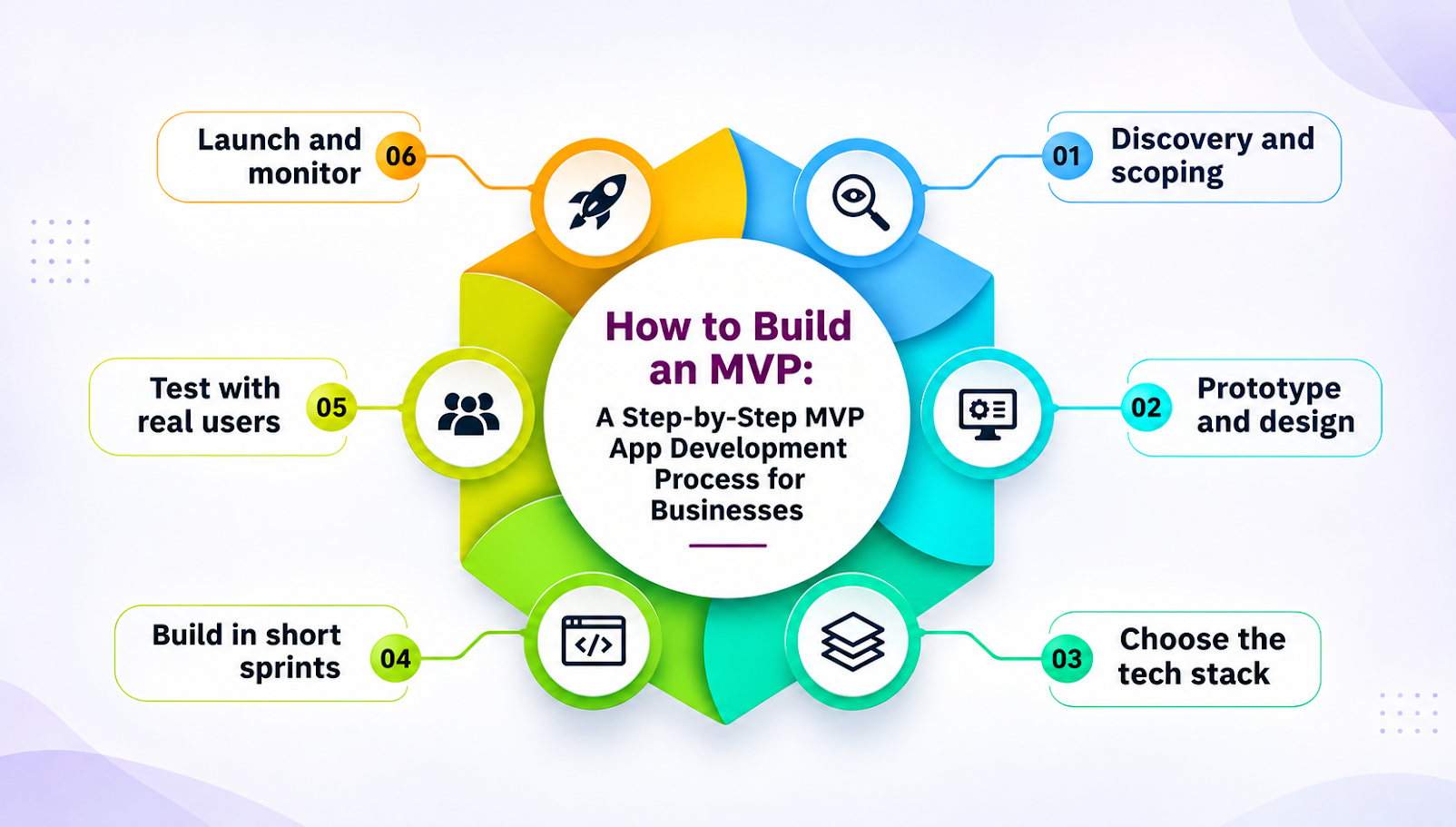
- Discovery and scoping. Create interactive story-study results. These are brief explanations of the tasks that each user must do. Determine the budget, success measures, and definition.
- Prototype and design. Build clickable screens and test them with users. Fixing a design is far cheaper than fixing code.
- Choose the tech stack. Your stack is the set of tools and languages the product runs on. Pick one that fits your budget and your growth plans.
- Build in short sprints. A sprint is a one- or two-week work cycle. Each sprint delivers something you can see and test.
- Test with real users. Run a beta with a small group. Track bugs, confusing screens and how people actually use the product.
- Launch and monitor. Release to your first customers. Monitor the success metric identified during planning.
If you’ve ever asked yourself how to develop an MVP without losing scope control, this sequence is an answer. This development technique, known as agile software development, provides a distinct output at each step. You will always know the status of your project.
Who Should Be in Your MVP App Development Team?
Even the most minimal viable product needs an adequate team to build it. Small teams work quickly, but every function has to be covered. You or your trusted advisor acts as the product owner, the person who’s knowledgeable about the client and is responsible for the final decision on what is going to be included in the product. A designer helps visualise the concepts by making user-friendly screens.
Developers program the product and ensure the code is manageable. The tester checks each product feature before it goes public. In a small project, one person can work in two roles. The senior developer can also be the tester. However, you must still perform all roles. A missing tester usually shows up as bugs on launch day. The product owner role is the one you cannot hand off completely. A partner can guide you, but only you know your customers and your goals.
Conclusion: Turn Your Business Idea Into a Software with GetAProgrammer
Every successful software product starts as an idea that someone was willing to test. The journey has three clear stages. You plan around one real problem. You build only what proves the idea. Then you launch to a small group, measure results and learn. Skip a stage and the risk climbs fast. Follow them in order, and your budget works harder. Your team stays focused, and your customers help shape what comes next. That is what a good custom software product development company looks like. It is not about writing the most code. It is about making the smartest decision at each stage.
GetAProgrammer collaborates with global entrepreneurs, small and medium-sized enterprises (SMEs), and medium-sized businesses at any stage of the MVP journey. At the planning stage, our expertise helps you test the idea and set KPIs. We can also help you trim features to the core essentials. During development, we build your product in quick iterations, so you can track progress and control the scope. Finally, for product launch, we advise you on how to measure KPIs, collect feedback, and prepare for future launches.
Looking for a partner who builds lean and builds right?
GetAProgrammer helps business founders and SMEs plan, design and ship MVPs that are ready to grow.
Frequently Asked Questions
How long does it take to build an MVP?
It depends on scope. A focused MVP is usually measured in months, not years. MVP software product development moves fastest when the feature list is fixed, and decisions are quick. A discovery phase gives you a reliable product timeline.
What is the difference between a prototype and an MVP?
A prototype shows how a product might look and work. It is usually a set of clickable screens with no real data behind them. An MVP is a working product that real users rely on. You test ideas with a prototype and test the market with an MVP.
Is an MVP only for startups?
No. MVP development for startups or startup software development is the classic use, but established businesses benefit just as much. An SME replacing legacy systems can launch a new customer portal as an MVP. That approach limits risk and builds staff support.
How do I develop a software product if I am not technical?
You do not need to code. Developing a software product is mostly about clear thinking. You need to know your users, your problem and your success metric. A trusted partner handles the technical side and explains each decision in plain English.


