How to Build a SaaS Product from Scratch: A Practical Guide for Startups and Businesses

Published On - November 4, 2026
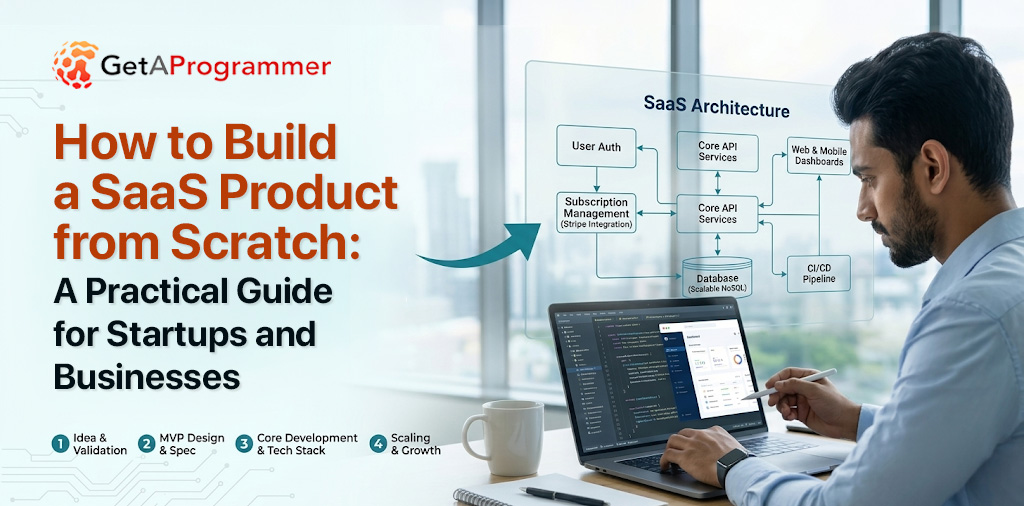
You have got an idea, a ballpark budget, and a developer’s quote sitting in your inbox, either suspiciously low or high enough to make you think twice.
That is pretty common. Most founders reach this point before they know how to build a SaaS product properly, and that gap is where money quietly disappears.
This guide is for Australian founders and SME owners who want a straight answer: How do you take an idea and turn it into paying customers? It reflects how experienced software developers in Australia plan, build and launch subscription software, including the parts that rarely appear in a quote.
By the end, you will know the steps, the realistic costs, the legal points to get right and how to choose who builds it.
What Is a SaaS Product, and Why Build One Now?
A SaaS (software as a service) product is software your customers use in a browser or app and pay for by subscription. You host it, update it and support it. They never install or maintain anything.
The appeal is recurring revenue. Instead of selling a project once, you earn every month a customer stays. For an SME, it can also turn a process you already run well into a product other businesses will pay for.
The local market is large, but it is no longer easy.
Gartner forecasts Australian organisations will spend about AUD 33.6 billion on public cloud services in 2026, with SaaS the biggest category at almost AUD 16.4 billion.
Gartner also expects SaaS growth to slow to 13.8% as buyers cut unused licences and scrutinise every app they pay for.
What does that mean for you? Buyers are spending, but they are pickier. Good SaaS product development starts with a problem customers already feel, not a feature list.
How to Build a SaaS Product: The Step-by-Step SaaS Development Process
Every product is different, but this order holds for almost every build. Skip a step, and you usually pay for it later.
Validate the Problem Before You Write Code
CB Insights reviewed 101 startup post-mortems and found 42% cited no market need as a reason they failed. That was the most common cause, ahead of running out of cash at 29%.
Validation costs far less than building. Before you spend a dollar on development:
- Interview 15 to 20 potential customers about their problem, not your solution
- List what they use today and what it costs them
- Ask for a commitment: a pre-order, a paid pilot or a letter of intent
If nobody will commit, you have learned something valuable for the price of a few coffees.
Scope a Minimum Viable Product
SaaS MVP development means building the smallest version that solves the core problem well enough for someone to pay. Not a demo. Not a half-finished full product.
A useful test: write down the one job your product must do. Every feature that does not support that job goes on a later list. Most founders find their first scope is two or three times bigger than it needs to be.
Choose a Pricing Model Early
Pricing shapes the product. Per-user pricing needs user management. Usage pricing needs metering. Tiered plans need feature controls.
| Model | Works Well When | Watch Out For |
|---|---|---|
| Per user (seat) | Value grows with team size | Customers sharing logins |
| Tiered plans | Buyers have clear basic and advanced needs | Too many tiers confuse buyers |
| Usage-based | Value tracks volume, such as invoices or bookings | Unpredictable bills worry small buyers |
| Flat monthly fee | Simple product, small business buyers | Undercharging your largest customers[cite: 7] |
Settle the model before development starts, even if the price points change later.
Pick a Tech Stack That Can Grow
You do not need to be technical, but you should understand three decisions:
- Multi-tenancy: one system serving many customers, with each customer’s data kept separate. This sits at the heart of most SaaS products.
- Cloud hosting: AWS, Microsoft Azure and Google Cloud all run Australian data centres, which helps when buyers ask where their data lives.
- Common frameworks: well-supported technologies make it easier to hire people to maintain the product later.
Ask any developer why they recommend a stack. “It is what we know” is honest, but it should not be the only reason.
Design for the First Five Minutes
Users judge a SaaS product quickly. A clickable prototype lets you test sign-up, onboarding and the first useful result with real users while changes are still cheap.
Build in Short Sprints
Agile development splits work into two-week sprints, each ending with working software you can see. You can reprioritise after every sprint instead of finding problems at the end.
Ask for a demo every sprint. If a team cannot show progress every two weeks, treat that as a warning sign.
Get Security and Compliance Right From Day One
Australian rules shape how you handle customer data:
- Privacy Act 1988: businesses with annual turnover above A$3 million must follow the 13 Australian Privacy Principles. Smaller businesses are covered too if they handle health information or trade in personal information (OAIC).
- Your customers’ standards: larger buyers bound by the Act will expect you to meet them, regardless of your turnover.
- Data location: buyers in health, finance and government often ask whether data is stored onshore.
- Basic security: encryption, role-based access, audit logs and tested backups belong in the first release.
The OAIC has argued for removing the small business exemption, so build as if the Act already applies to you.
Test, Launch and Onboard
Run a closed beta with your validation customers first. Watch where people get stuck, fix the biggest issues, then open sign-ups. A simple in-app onboarding checklist often drives retention more than any ad campaign.
Measure and Improve
Launch is the start, not the finish. Track monthly recurring revenue (MRR), churn (customers who cancel), activation rate and support requests. Let that data, not opinion, choose your next features.
Who Should Build It? In-House, Freelancers or a Development Partner
There is no single right answer. The best choice depends on your budget, your timeline and how central the software is to your business.
| Option | Best For | Cost Profile | Main Risks |
|---|---|---|---|
| In-house team | Funded startups where software is the core business | Salaries plus 12% super, leave, equipment and hiring time | Slow to hire, hard to scale down, needs technical leadership |
| Freelancers | Small, well-defined tasks or prototypes | Lowest hourly rates | Patchy availability, nobody owns the whole product |
| Australian development partner | Founders who need a full team fast without permanent hires | Fixed-scope or sprint-based pricing | Quality varies widely, so vet carefully[cite: 8] |
When In-House Is the Better Choice
If software is your whole business and you have raised capital, you will eventually need your own technical team. A partner can build the first version and help you hire, but long-term SaaS product development usually moves in-house once you find product-market fit.
Hiring carries obligations. Employers must pay the super guarantee, which has been 12% of ordinary time earnings since 1 July 2025 (ATO).
When Freelancers Make Sense
Freelancers suit a landing page, a design sprint or a contained feature. They are a risky choice for a whole product, because nobody is accountable for architecture, security and testing across the build.
Classification matters too. Since 26 August 2024, the Fair Work Act looks at the real substance and practical reality of a working relationship, not only the contract label (TGLaw summary).
A “contractor” who works set hours, only for you, under your direction may legally be an employee.
When a Development Partner Fits
SaaS development for startups often suits a partner model. You get a product lead, designers, developers and testers from week one, and the team scales down after launch.
The trade-off is that you must manage the relationship closely and protect what you own.
Protect Your Intellectual Property
Whoever builds it, your contract needs a clear IP assignment clause. Code written by a contractor or agency generally belongs to its author unless the contract assigns it to you.
Make sure ownership of source code, designs and documentation transfers to your company, and that you can access the code repository from day one.
What Does It Cost to Build a SaaS Product in Australia?
Anyone explaining how to build a SaaS product should be upfront about money. Cost depends on scope more than anything else, so treat the ranges below as a starting point, not a quote.
| Stage | What You Get | Typical Timeframe | Indicative Cost (AUD) |
|---|---|---|---|
| Discovery and prototype | Validated scope, user flows, clickable prototype, technical plan | 3 to 6 weeks | $10,000 to $40,000 |
| MVP | Core features, sign-up, billing, admin panel, cloud setup | 3 to 6 months | $60,000 to $200,000 |
| Full product | Integrations, advanced user roles, reporting, mobile apps | 6 to 12+ months | $200,000 to $600,000+ |
| Ongoing running costs | Hosting, support, security updates, improvements | Every month | Often 15% to 25% of build cost per year[cite: 9] |
Indicative ranges only, based on typical Australian project rates. Your figure will vary with scope, integrations, compliance needs and where your team is based.
What Pushes the Price Up
- Integrations with accounting, CRM or payment systems
- Compliance needs, such as health or financial data
- Multiple user roles and complex permissions
- Mobile apps alongside the web app
- Changing scope halfway through the build
The most expensive line is usually the last one. A disciplined SaaS development process with a fixed MVP scope protects your budget better than any hourly rate.
Costs Founders Forget
Payment gateway fees, email and SMS services, security testing, monitoring tools and support staff all arrive after launch. Budget for them before you sign off the build.
Funding Support Worth Checking
Some product work may qualify for the R&D Tax Incentive. For companies with aggregated turnover under A$20 million, the refundable offset equals the company tax rate plus an 18.5% premium (business.gov.au). Routine development often does not qualify, so speak to a registered tax adviser before you count on it.

Not sure where your idea sits in this table?
Five Mistakes That Sink SaaS Builds
Most failed projects do not fail on code. They fail on decisions made before and around it.
- Building before validating. Months of work on a product nobody asked for is the most expensive mistake on this list.
- Choosing the cheapest quote. A low quote often means missing testing, weak security or a scope that will grow later. Compare what is included, not only the total.
- Overloading version one. Every extra feature delays launch and the feedback you need.
- Leaving security and privacy until later. Retrofitting access controls and encryption costs far more than building them in.
- Not owning your code. Without an IP assignment and repository access, switching developers can mean starting again.
How to Choose Software Developers in Australia for Your SaaS Build
The team you choose will shape your product, budget, and timeline.
Use this checklist when comparing quotes:
- They ask about your customers and revenue model before talking technology
- They can show SaaS products they have launched and let you speak with past clients
- They start with a discovery phase that produces a written scope
- They work in sprints, with a demo you can see every two weeks
- The contract assigns all IP to you and gives you repository access
- They explain who handles security, testing and hosting after launch
- They tell you when a feature is not worth building
Be careful with any team that says yes to everything. A good partner pushes back, because your budget is finite.
Turn Your Idea Into a Product People Pay For
Building a SaaS product comes down to a few disciplined choices. Validate before you build. Keep version one small. Pick a pricing model early. Treat security and privacy as features. Own your code from day one.
Get those right, and the technology becomes the easier part.
GetAProgrammer is an Australian custom software development company working with founders, CTOs and SME owners. The team supports SaaS development for startups and growing businesses, from discovery and MVP scoping through to launch and ongoing improvement.
Comparing quotes right now?
Frequently Asked Questions
How long does it take to build a SaaS MVP?
Most MVPs get from approved scope to launch in about three to six months. If you keep things simple, like a focused product with minimal integrations, it can go even faster. But when you need complicated permissions, tricky payment flows, or you are dealing with health or finance data and all the compliance that comes with it, expect it to take longer. A quick discovery phase helps you set a realistic timeline.
Can I build a SaaS product without technical skills?
Yes. You do not have to be a developer to succeed. Plenty of founders are not. You can test your ideas with no-code tools before bringing in a skilled team to build the real thing. Your main job is to really understand the problem, know your customer, and set priorities. Keep asking questions until every technical choice feels clear.
How much does a SaaS MVP cost in Australia?
As an indicative range, many MVPs cost between $60,000 and $200,000 AUD. The final figure depends on features, integrations, design depth and compliance needs. Ongoing hosting, support and improvements add further costs each year. Always ask for a written scope so you can compare quotes fairly.
What is the first step in how to build a SaaS product?
Before anyone writes a line of code, go talk to potential customers. Make sure they truly have the problem you want to solve. Find out what they are currently doing about it and see if they are willing to commit—even to a paid pilot. Real feedback helps shape your MVP and keeps you from wasting time building stuff nobody wants.
Does my SaaS product need to comply with the Privacy Act?
If your business brings in over A$3 million a year or deals with health information, the Privacy Act 1988 definitely applies to you. Even smaller businesses cannot ignore it. Big clients often expect you to follow these rules, and there is talk of changing the small business exemption anyway. Honestly, it is cheaper and easier to think about privacy from the start.
Should I hire freelancers or a development company?
Freelancers suit small, clearly defined tasks. A development company suits a full product that needs design, development, testing and security working together. If software is your core business and you have funding, plan to build an in-house team over time. Many founders start with a partner, then hire.


